



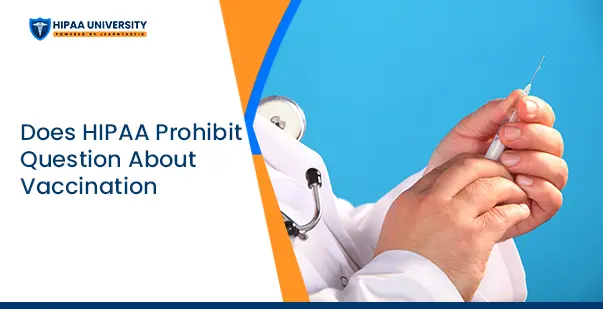
Does HIPAA Prohibit Questions About Vaccination?

October 4, 2024
In today’s healthcare environment, privacy is a big deal. That’s especially true when it comes to health records and vaccine information. But one question keeps coming up: Does HIPAA stop someone from asking about your vaccination status?
According to a Harvard Health article, HIPAA mandates strict confidentiality, but it doesn’t make vaccination questions off-limits in every situation. While HIPAA requires strict privacy for medical records, it does allow room for organizations to ask about vaccines, especially when it comes to public health or safety rules.
There’s a lot of confusion around HIPAA and vaccination—what’s protected, what’s allowed, and who can ask. In this blog, we’ll break down what HIPAA actually says about vaccination discussions, where the line is drawn, and how organizations can ask the right questions without crossing it.
To understand the connection between HIPAA and vaccination, we need to look at how the law adapted during COVID-19.
Overview of HIPAA and Its Role During COVID-19
To understand the connection between HIPAA and vaccination, we need to look at how the law adapted during COVID-19.
HIPAA—the Health Insurance Portability and Accountability Act—is all about protecting private health data. But when the COVID-19 pandemic hit, the usual rules didn’t always fit the fast-changing needs of public health. That meant parts of HIPAA had to adapt to support emergency efforts while still protecting patient privacy.
Here’s how HIPAA flexed during the pandemic:
- The Privacy Rule still held firm – Patient information couldn’t just be shared freely. HIPAA continued to protect sensitive data and limit who could access it without permission.
- Some exceptions were made – During COVID-19, the government allowed more flexibility in how providers could share health information to help track and manage the outbreak.
- Telehealth took off – With more virtual visits than ever before, HIPAA guidelines were temporarily relaxed to make remote care easier, without compromising privacy.
- Reporting to public health agencies was allowed – HIPAA already permits health info to be shared with public health departments for disease control. That applied to COVID and vaccine data too.
- Vaccination info stayed protected – Even though vaccine status was widely discussed, it still fell under HIPAA’s privacy rules and had to be handled with care.
- Emergency authorizations required updates – As new treatments and vaccines rolled out under Emergency Use Authorizations (EUAs), HIPAA policies were adjusted to accommodate the changes.
- Healthcare providers got breathing room – To help them respond quickly, some temporary waivers made it easier to manage patient data under pressure.
How HIPAA Applies to Vaccine Status
Vaccine records are considered Protected Health Information (PHI) under HIPAA, which means they’re treated like any other private medical detail. But there are situations where sharing that information is allowed—or even expected.
Let’s break it down:
- Yes, it’s private – Your vaccine status is protected just like your health records, and providers need to handle it responsibly.
- Some sharing is allowed – Healthcare professionals can share your vaccination status without your consent if it’s required by law or needed for public health purposes.
- Employers can ask – While HIPAA doesn’t stop your employer from asking about your vaccination status, they’re responsible for keeping that information confidential.
- Consent still matters – Outside of specific exceptions, your permission is needed to disclose your vaccine information for non-medical reasons.
- Public health rules take priority – During a public health emergency, HIPAA allows vaccination status to be shared with agencies working to contain outbreaks. This is a common scenario covered under HIPAA and vaccination protocols during public health emergencies.
- Virtual visits are no exception – If you discuss your vaccine status during a telehealth appointment, it’s protected the same way it would be in person. Even in remote care, HIPAA and vaccination compliance must be maintained.
🔗 Read More: Is Gmail HIPAA Compliant: What Healthcare Providers Need to Know
Is Asking for Proof of a Vaccine a HIPAA Violation?
In short: no. HIPAA doesn’t prevent someone from asking if you’ve been vaccinated. Just asking the question—or even requesting proof—is not a violation of HIPAA.
The law only limits how healthcare providers and certain organizations share your vaccination status, not whether someone else can ask you about it.
This distinction is often misunderstood, which is why thorough HIPAA training is essential for staff handling patient interactions.
Understanding HIPAA vaccine rules can help prevent confusion about what counts as a violation.
When HIPAA Allows Questions About Vaccination
There are situations where HIPAA guidelines allow your vaccine status to be shared, especially when public health or safety is involved. Here are a few common scenarios:
- Public Health Reporting – Doctors and clinics can report vaccination data to local or state health departments to help manage disease outbreaks.
- Emergency Situations – During a public health emergency, like a pandemic, sharing this info might be essential to control the spread of illness.
- Following Laws and Regulations – If a law says vaccine status must be disclosed, HIPAA makes room for that.
- In the Workplace – Employers can ask if you’re vaccinated to maintain a safe work environment, but they must keep that information private.
- Within Healthcare Settings – Doctors can share your vaccine status internally to make informed treatment decisions or for continuity of care.
These are clear examples where HIPAA vaccine rules allow for disclosures in line with public health needs.
What Happens if HIPAA Is Violated?
Violating HIPAA doesn’t just mean breaking a rule—it can have real consequences. Here’s what’s at stake:
- Legal Trouble – Depending on the situation, fines can be hefty. In some cases, legal action or investigations follow.
- Loss of Trust – A breach can damage a provider’s reputation and make patients hesitant to share important health information.
- Operational Impact – Fixing a HIPAA violation often pulls staff away from their regular work and can slow down patient care.
- Financial Costs – Between legal fees, fines, and recovery efforts, a single breach can get expensive fast.
- Regulatory Oversight – Organizations that break the rules may face more audits and stricter monitoring afterward.
That’s why regular HIPAA training and clear policies are critical for avoiding these issues.
🔗 Read More: Who is Responsible for Enforcing HIPAA Regulations?
What’s Ahead: Future Trends in HIPAA and Vaccine Data
As healthcare keeps evolving, so does the way we handle sensitive information like vaccination records. The challenge? Balancing patient privacy with the growing demand for public health transparency. Here’s a look at where things seem to be heading:
- More Data Sharing for Public Health
We’ll likely see expanded efforts to share vaccination data with public health agencies, especially during outbreaks—to help with faster tracking and response. - Smarter Digital Health Systems
As more providers use electronic health records (EHRs) and advanced tools, there’s going to be a tighter focus on how vaccine data is stored, accessed, and protected. - Telehealth Is Here to Stay
Virtual care isn’t going anywhere. That means HIPAA rules will need to keep up, making sure vaccine information shared during online visits remains fully secure. - Tougher Compliance and Enforcement
With the rise in data breaches, regulators are expected to step up enforcement and introduce stricter checks to ensure vaccine data is being handled correctly. - Changing Public Health Laws
New health threats often lead to new regulations. HIPAA will need to adjust accordingly to stay aligned with updated public health guidelines. - Stronger Data Protection Tools
Expect to see better encryption, access controls, and other privacy tools designed specifically to guard vaccination data from unauthorized access. - More Control for Patients
Patients want to know who can see their data, and decide how it’s shared. The future of HIPAA may include clearer consent options and better tools for patients to manage their own vaccination records.
As the rules evolve, updated HIPAA training will be necessary to stay compliant with both federal law and patient expectations.
Conclusion
So, does HIPAA prohibit questions about vaccination? Not really. While the law protects your personal health information, it doesn’t stop someone from asking if you’ve had a vaccine—especially when it relates to safety or public health.
What matters most is how that information is used and shared. HIPAA is there to make sure it’s done responsibly, with your privacy in mind.
If you work with health data—or just want to better understand the rules—taking a HIPAA training course is one of the best ways to stay compliant and informed.

HIPAA Courses
Recent Posts
Blockchain Healthcare Technology: HIPAA Compliant?
March 25, 2026
Does HIPAA Apply to Wearable Health Technology?
March 19, 2026
 Your Cart