



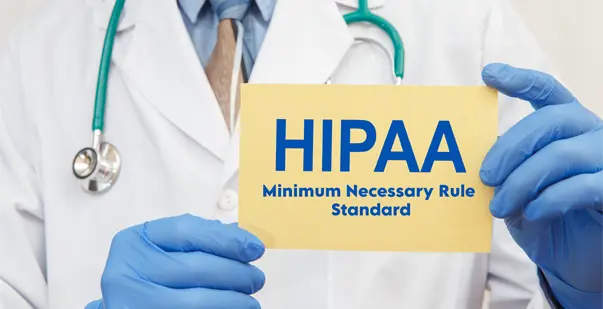
The HIPAA Minimum Necessary Rule Standard

July 16, 2024
When patients hand over personal health information, they expect it to be handled with care. And in healthcare, privacy isn’t just expected—it’s a legal obligation. The Health Insurance Portability and Accountability Act (HIPAA), established in 1996, provides the foundation for protecting patient information in every form: written, verbal, or electronic.
A key part of that law is the HIPAA Minimum Necessary Rule, which requires healthcare providers, insurers, and related entities to use or disclose only the smallest amount of Protected Health Information (PHI) needed for a specific task. No more, no less.
In this post, we’ll break down how the rule works, why it matters, and what happens if it’s not followed. We’ll also look at how proper HIPAA training and clear internal policies help organizations stay compliant and protect the trust patients place in them.
What Does the HIPAA Minimum Necessary Standard Require?
The Minimum Necessary Standard under HIPAA is all about limiting exposure. Here’s what it involves:
- Who Must Follow It: All HIPAA-covered entities—such as healthcare providers, health plans, clearinghouses, and business associates—must comply.
- Limiting Access to PHI: Organizations are required to make reasonable efforts to use, request, or share only the PHI necessary for a given purpose.
- Routine Tasks: For recurring tasks like billing or reporting, organizations must create protocols that clearly define what information can be shared.
- Non-Routine Situations: If the disclosure is outside of day-to-day operations, it must be reviewed on a case-by-case basis to ensure it meets the standard.
- Trusting Requests: Covered entities can generally rely on another covered entity or business associate’s judgment when PHI is requested—if it’s clear the request is for a permitted purpose under HIPAA.
- When It Doesn’t Apply: The Minimum Necessary Rule does not apply when:
- A provider shares PHI for treatment
- A patient asks for their own health records
- The patient gives written consent
- A disclosure is required by law
- It’s requested by the Department of Health and Human Services (HHS) for oversight
- It falls under HIPAA’s Administrative Simplification Rules
- Policies and Procedures: Every organization must develop policies that define what “minimum necessary” looks like for each job role or department.
- Staff Education: Employees must be trained to apply this rule in their daily responsibilities. Completing a HIPAA certification or enrolling in HIPAA training is a key part of that process.
🔗 Read More: Who Must Comply with HIPAA Rules and Regulations?
What Are the Consequences of HIPAA Non-Compliance?
When organizations fail to follow HIPAA standards—including the Minimum Necessary Rule—the consequences can be serious:
- Fines and Penalties: The Office for Civil Rights (OCR) within the Department of Health and Human Services (HHS) can issue penalties ranging from $100 to $50,000 per violation, with a possible annual cap of $1.5 million.
- Criminal Charges: Intentional violations can result in criminal charges, with penalties including fines up to $250,000 and prison time up to 10 years.
- Civil Lawsuits: Although HIPAA doesn’t offer a direct right to sue, individuals may file claims under state law if their information was mishandled.
- Audits and Investigations: Non-compliance can lead to audits, additional oversight, and follow-up actions that consume time and resources.
- Loss of Trust: Patients may choose to leave a practice that fails to protect their information, and it could harm relationships with partners.
- Reputation Damage: A publicized breach can tarnish an organization’s image and impact future business opportunities.
- Operational Risk: Business associates might cut ties with non-compliant partners to protect their own standing.
Avoid penalties. Enroll in a HIPAA certification course
🔗 Read More: What is the HIPAA Compliance Checklist?
Conclusion
The HIPAA Minimum Necessary Rule isn’t just about protecting data—it’s about protecting people. It ensures that only the essential information is shared and reduces the chance of exposure, misuse, or loss.
By building strong internal safeguards, clearly defining roles, and providing regular HIPAA training or HIPAA certification online, healthcare organizations can not only meet legal requirements—but also reinforce patient trust.
In a healthcare world that’s more digital and connected than ever, protecting personal health information must remain a top priority.

HIPAA Courses
Recent Posts

What Is Medical Identity Theft? Risks, Impact, and Prevention
November 25, 2025

HIPAA Pharmacy Compliance: Updates and Best Practices
November 21, 2025
 Your Cart